
K-ETA is South Korea’s electronic travel authorisation for visa-exempt nationals, costing ~£5.50 and valid for 3 years. Unlike a traditional visa, K-ETA requires no embassy visit and processes within 72 hours.
However, K-ETA does not guarantee entry. Final decisions rest with immigration officers at the port of arrival. K-ETA is a digital pre-clearance system, not a traditional consular visa.
British passport holders are temporarily exempt from K-ETA through 31 December 2026, allowing visa-free entry for up to 90 days without any electronic authorisation. Comparing K-ETA with other electronic travel authorisations worldwide helps prepare for future travel changes.
K-ETA vs Visa: What Is the Difference?
K-ETA is a pre-travel electronic screening for visa-exempt nationals, not a visa. K-ETA permits tourism, transit, and short-term business (C-3 equivalent) only, not paid employment or stays exceeding 90 days. K-ETA does not guarantee entry, as the final decision rests with immigration officers at the port of entry.
Check visa-free eligibility
No: Apply for a traditional visa at a Korean embassy. Yes: Proceed to step 2.
Check K-ETA exemption
22 countries, including the UK, exempt through 31 Dec 2026. Yes: Enter visa-free. No: Proceed to step 3.
Apply for K-ETA online
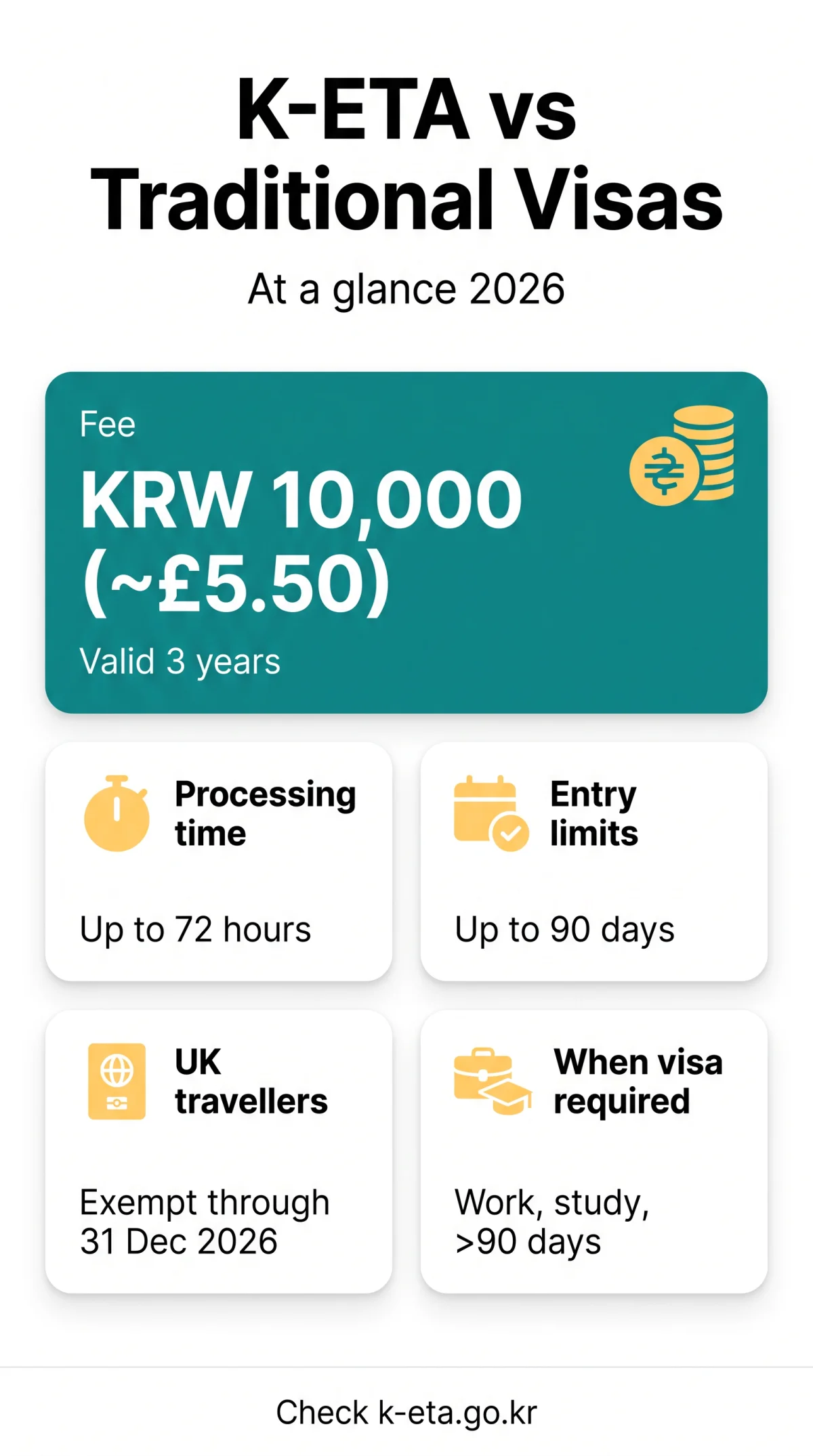
Fee KRW 10,000 (~£5.50). Processing up to 72 hours.
Confirm trip purpose
Work, study, or stay over 90 days? Yes: Traditional visa. No: K-ETA is sufficient.
K-ETA vs Traditional South Korea Visa – Cost, Process and Requirements
K-ETA (Korea Electronic Travel Authorization) costs KRW 10,000 (~£5.50) and processes fully online within 72 hours, versus a traditional C-3 visa requiring USD $40-$80, embassy visits, and 5-15 business days.
Cost Comparison – K-ETA Fee vs South Korea Visa Fee
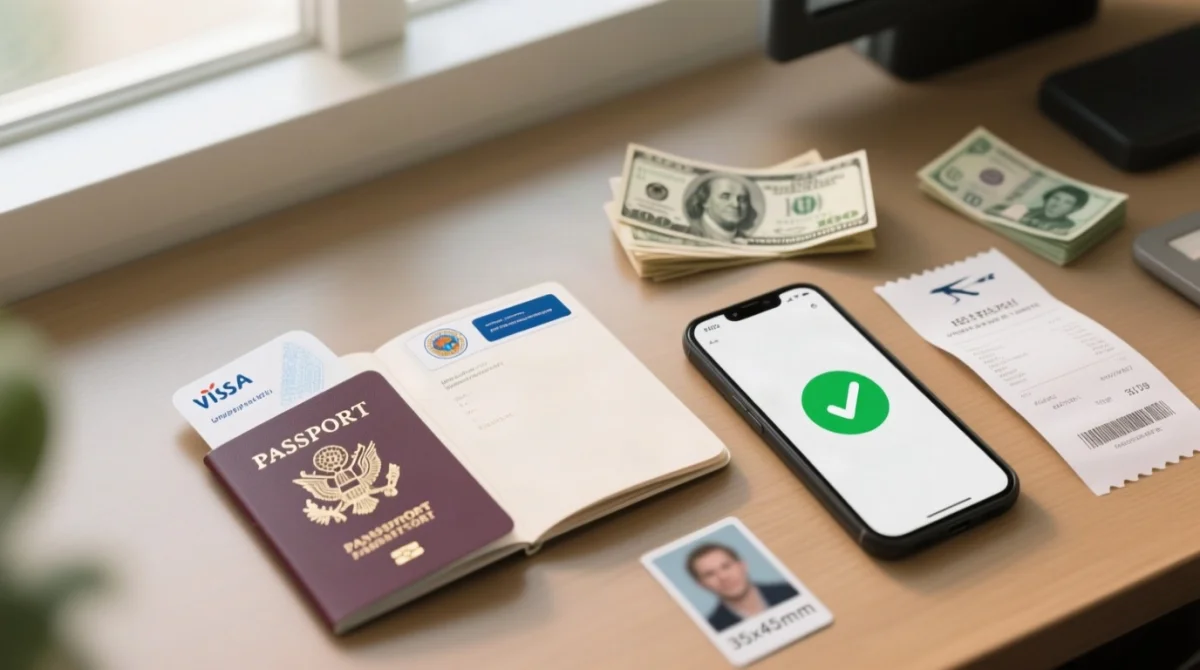
K-ETA costs KRW 10,000 (~£5.50), non-refundable even if denied, and requires only passport details and a JPEG photo (white background). A traditional C-3 tourist visa costs USD $40-$80 depending on the consulate and demands an original passport, a 35mm x 45mm photograph, business and invitation letters, flight confirmation, and an application form.
Processing Time – How Long Does Each Take?
K-ETA processes within 72 hours through a fully online portal; no expedited service is available. Airlines verify K-ETA status electronically through APIS (Advance Passenger Information System) at check-in or boarding, so no printout is required.
Terms
Review and accept the terms of use.
Email Verify
Verify your email address.
Passport Info
Enter your passport details.
Application Info
Complete the application information.
Check
Review all submitted information.
Payment
Pay the KRW 10,000 fee.
Complete
Receive your application confirmation.
The K-ETA Center (telephone 02-2666-0463) does not provide telephone or face-to-face consultations; direct all inquiries through the online [Ask Us] board at k-eta.go.kr. A traditional visa takes 5-15 business days and is recommended 1-2 months before travel, requiring an embassy or consulate appointment.
Validity and Entry Type – Multiple Entry vs Single Entry
K-ETA is valid for 3 years with multiple entries. A traditional tourist visa is typically single-entry, valid for a 90-day stay. K-ETA validity is linked to your passport: if it expires before 3 years, K-ETA matches that expiry date. For UK citizens, passport validity must cover the departure date for stays up to 90 days; for long-term visas, passport expiry must be at least 6 months after arrival.
K-ETA for UK Travellers – What British Citizens Need to Know in 2026
British passport holders are temporarily exempt from K-ETA through 31 December 2026, entering South Korea visa-free for up to 90 days for tourism or short-term business without any electronic authorisation. This exemption, part of the ‘Visit Korea Year’ initiative, was introduced on 1 April 2023 and extended twice, most recently through 31 December 2026.
UK citizens must hold an onward or return ticket and a passport valid beyond the departure date. After 31 December 2026, British nationals will likely need to apply for K-ETA before travel. Bookmark www.k-eta.go.kr to check exemption status before booking 2027 trips.
| Feature | K-ETA | UK ETA |
|---|---|---|
| Fee | ~£5.50 | £10 |
| Validity | 3 years | 2 years |
| Max stay per entry | Up to 90 days | Up to 6 months |
Global Electronic Travel Authorisations Compared
The definitive comparison table covers K-ETA, US ESTA, EU ETIAS, UK ETA, Canada eTA, and Australia ETA across fees, validity, stay limits, and processing methods.
| Feature | K-ETA (South Korea) | US ESTA | EU ETIAS | UK ETA | Canada eTA | Australia ETA |
|---|---|---|---|---|---|---|
| Fee | KRW 10,000 (~£5.50) | $21 | €7 (expected) | £10 | CAD $7 | AUD $20 |
| Validity | 3 years | 2 years | 3 years (expected) | 2 years | 5 years / passport expiry | 12 months |
| Max stay | Up to 90 days | 90 days | 90 days in 180 days | 6 months | 6 months | 90 days per entry |
| Eligible nationalities | 96 countries | 42 VWP countries | 60+ visa-required countries | Non-visa nationals | Visa-exempt countries | 30+ eligible countries |
| Application method | Online (website + app) | Online | Online (expected) | Online (website + app) | Online | Online |
| Biometrics | Photo upload only | Photo upload | Fingerprints (expected) | Photo upload | Photo upload | Photo upload |
| Processing time | Up to 72 hours | Typically minutes | Minutes to 96 hours (expected) | Typically under 72 hours | Typically minutes | Typically minutes |
| UK traveller status (2026) | Temporarily exempt through 31 Dec 2026 | Required | Not yet launched | Required | Required | Required |
K-ETA vs US ESTA and EU ETIAS
K-ETA vs US ESTA – Key Similarities and Differences
K-ETA costs approximately £5.50 and remains valid for 3 years, while US ESTA charges $21 for a 2-year authorisation. Both are fully online, non-refundable, and offer no appeal on refusal. A refused K-ETA requires a C-3-9 visa at a Korean embassy; a refused ESTA requires a B-1/B-2 visa at a US embassy. ESTA covers 42 Visa Waiver Program countries and has operated since 2009, whereas K-ETA covers 96 eligible nationalities for a single destination and launched in 2021. Neither permits paid employment.
K-ETA vs EU ETIAS – What UK Travellers Should Watch For
EU ETIAS, not yet launched as of 2026, will span 27 Schengen states and require fingerprints rather than a simple photo upload. K-ETA requires only a passport and a JPEG photograph, making it lighter on documentation. ETIAS is expected to cost €7 for 3 years, near price parity with K-ETA. For UK travellers, ETIAS and K-ETA are separate, non-interchangeable authorisations for their respective destinations.
K-ETA vs UK ETA and e-Arrival Card
K-ETA vs UK Electronic Travel Authorisation – A Side-by-Side for British Passports
K-ETA costs ~£5.50 and is valid for 3 years with multiple entries, while the UK ETA charges £10 and lasts 2 years. Both K-ETA and the UK ETA are fully online authorisations for visa-exempt travellers, yet they apply to different destinations: K-ETA grants access to South Korea for up to 90 days per entry, whereas the UK ETA permits stays of up to 6 months per entry within its 2-year validity window. Both feature web portals and mobile apps for application.
K-ETA vs e-Arrival Card – They Are Not the Same Thing
K-ETA is a paid pre-departure authorisation (KRW 10,000, valid 3 years). The e-Arrival Card is a free digital form submitted within 72 hours before arrival. K-ETA holders are exempt from the e-Arrival Card. If you do not have K-ETA, you must submit the e-Arrival Card online before landing in South Korea. A paper arrival declaration form remains available upon arrival for those who prefer it.
K-ETA Exemptions, Refusals and Special Cases
Which Countries Are Exempt from K-ETA?
22 countries including the UK, United States and Japan are temporarily exempt from K-ETA through 31 December 2026. This exemption stems from the ‘Visit Korea Year’ tourism initiative, originally effective from 1 April 2023 and extended twice. Korean nationals returning home are always exempt. Verify your status on the K-ETA portal before each trip, as exemptions are reviewed periodically.
What Happens If My K-ETA Is Refused?
K-ETA refusals carry no appeal process and the KRW 10,000 fee is non-refundable. If denied on substantive grounds, your only recourse is applying for a standard C-3-9 consular visa at a Korean embassy, with processing typically taking 5 to 15 business days. You may reapply for K-ETA only if the refusal was due to incorrect information on your original application. Providing false information can result in approval refusal or cancellation, with penalties or entry restrictions under Korean law.
For airside transit at Incheon Airport without clearing immigration, K-ETA is generally not required. Dual nationals should note that K-ETA is tied to a specific passport number: switching passports, renewing your passport, or changes to your criminal record or infectious disease information require a new K-ETA application even if your current one has not expired. If you hold both K-ETA and a valid Residence Card or visa, your stay is granted according to the Residence Card or visa, not K-ETA.
FAQ
Do British citizens need a K-ETA for South Korea in 2026?
No. UK passport holders are exempt from K-ETA through 31 December 2026, entering visa-free for up to 90 days without any electronic authorisation.
Is K-ETA the same as a South Korea visa?
No. K-ETA is a pre-travel screening, not a visa. It does not allow employment, study, or stays over 90 days. A traditional visa is required for those purposes.
How much does K-ETA cost compared to a South Korea visa?
K-ETA costs KRW 10,000 (~£5.50). A traditional South Korea tourist visa costs USD $40-$80 depending on the consulate, plus document preparation costs.
What happens if my K-ETA application is refused?
No appeal; the KRW 10,000 fee is non-refundable. Apply for a C-3-9 consular visa at a Korean embassy. Reapply for K-ETA only if the refusal involved incorrect information.
Do I need to print my K-ETA approval?
No. K-ETA is verified electronically via airline APIS (Advance Passenger Information System) data at check-in or boarding.
Can I change from K-ETA to a work visa inside South Korea?
No. K-ETA permits tourism and short-term business only. Apply for a work visa (C-4 or E-series) at a Korean embassy before entering South Korea.
Do I need a K-ETA for airside transit at Incheon Airport?
Airside transit at Incheon without clearing immigration generally does not require K-ETA. Leaving the transit area or changing airports requires valid entry authorisation.
Can I use the same K-ETA for two different passports?
No. K-ETA is tied to a passport number; switching or renewing passports requires a new K-ETA application.
Sources and Editorial Notes
Last updated: 15 September 2026. Sources: K-ETA portal (k-eta.go.kr), UK Foreign Office travel advice for South Korea (gov.uk), Fragomen immigration updates, and CIBT visa service documentation. All fees, processing times, and validity periods were verified against these primary sources on 15 September 2026.
This article is reviewed by our editorial team every 60 days or whenever sources announce changes to K-ETA policy. This content is for informational purposes only and does not constitute legal or immigration advice.