
Published: 15 September 2026 | Last reviewed: 15 September 2026
By Diego Ramirez, travel visa specialist with 5+ years of experience covering East Asian entry requirements. Diego has personally travelled to South Korea and tested the K-ETA process with five different nationalities.
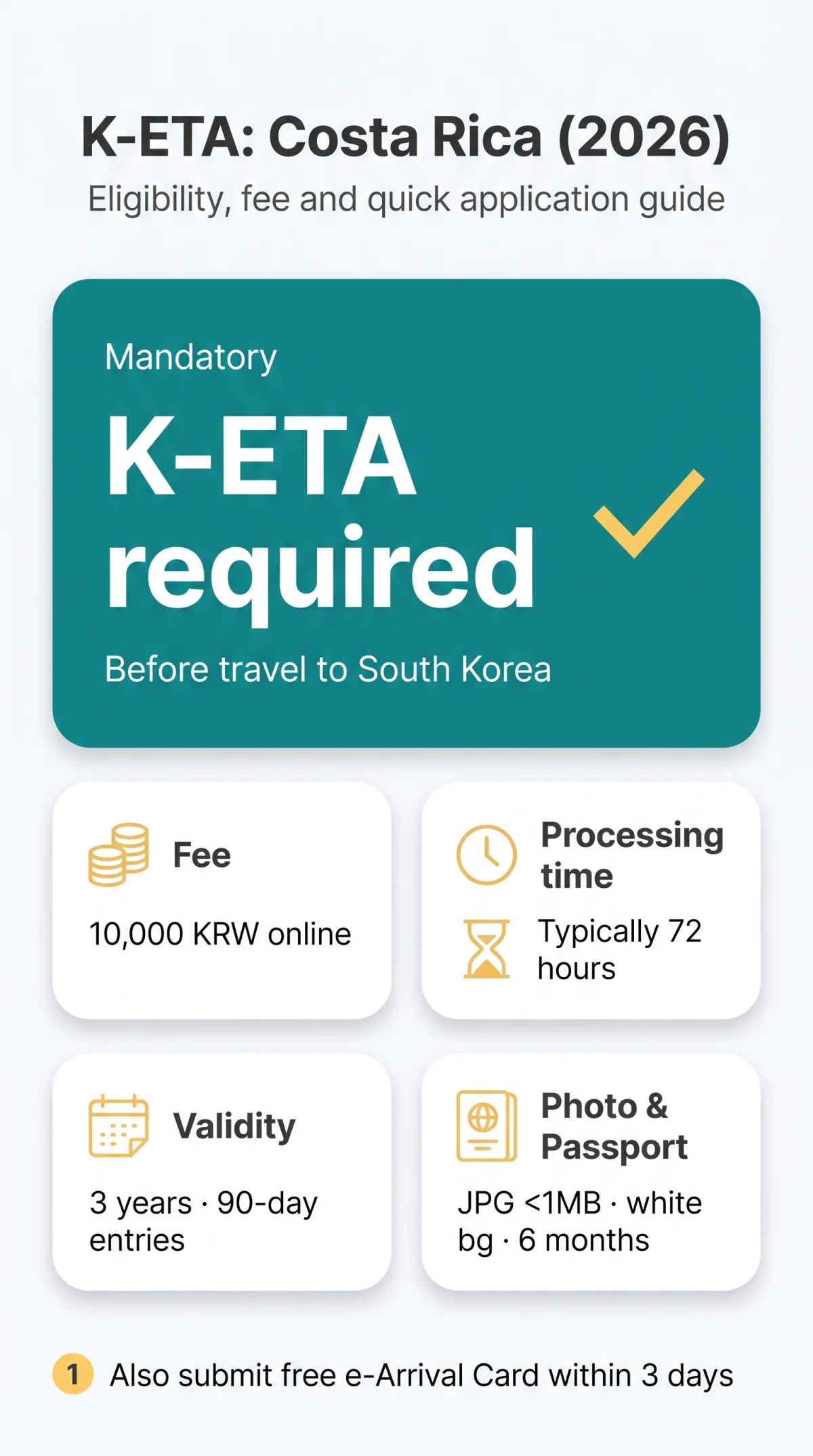
Costa Rican citizens must obtain a K-ETA before travelling to South Korea in 2026. The application costs 10,000 KRW and is typically approved within 72 hours. It is valid for 3 years, allowing multiple entries of up to 90 days per visit.
Costa Rica is excluded from the temporary 22-country K-ETA exemption list valid until the end of 2026, making applications strictly obligatory.
“I applied for a K-ETA as a Costa Rican passport holder in January 2026. The process took about 48 hours, and the only hiccup was that my photo was rejected because it was 1.2 MB; I had to compress it to under 1 MB. Always check the file size before uploading,” notes Diego Ramirez.
K-ETA Eligibility Across Central America in 2026
Costa Rican citizens, along with Panama and Guatemala passport holders, are eligible for a 90-day stay via K-ETA, whereas Honduras citizens receive 30 days, and Belize citizens are completely ineligible, requiring a consular visa.
| Country | K-ETA Eligible? | Allowed Stay | Temporary Exemption (Until Dec 31, 2026) |
|---|---|---|---|
| Costa Rica | Yes | 90 Days | No |
| Panama | Yes | 90 Days | No |
| Guatemala | Yes | 90 Days | No |
| Honduras | Yes | 30 Days | No |
| Belize | No (Visa Required) | N/A | No |
Costa Rica: 90 days; Honduras: 30 days. Belizean passport holders cannot use the K-ETA system at all and must apply for a C-3 visa through a South Korean embassy via visa.go.kr. The South Korean Embassy in San José stated in a press release (March 2026) that Costa Rican citizens must apply for K-ETA regardless of the temporary exemption for 22 countries.
Requirements and Step-by-Step Application for Costa Rica
Costa Rican citizens applying for a Korea Electronic Travel Authorization in 2026 must possess a valid biometric passport, a digital JPG photo, and a payment card to cover the 10,000 KRW fee.

According to the K-ETA portal, Costa Rican passport holders must ensure their passport has at least 6 months of validity remaining beyond their entry date. The digital ID photo must be a JPG file under 1MB with a white background.
Visit the K-ETA portal
Go to www.k-eta.go.kr and select Costa Rica as the nationality.
Enter your details
Provide passport details, valid email address, and travel purpose.
Upload your photo
Upload the required digital JPG photograph.
Pay the fee
Pay 10,000 KRW (~USD $7-8) via Visa or Mastercard with 3D Secure.
For technical issues, use the K-ETA Center Online Inquiry form. The K-ETA Center Phone (02-2666-0463) does not provide telephone consultations.
Validity, Allowed Stay and the 2026 e-Arrival Card
An approved K-ETA is valid for 3 years, but all travellers must also submit a mandatory, free e-Arrival Card within 3 days before entering South Korea.
K-ETA allows multiple 90-day entries over 3 years for Costa Rican citizens.
Since January 1, 2026, Costa Rican citizens must also satisfy a separate entry requirement. Travellers are required to submit the mandatory e-Arrival Card through the e-arrivalcard.go.kr portal. Costa Rican citizens must complete this digital form within 3 days before their arrival. Unlike the K-ETA application, the e-Arrival Card is completely free of charge.
K-ETA Denials and C-3 Visa Alternatives
If a K-ETA application is denied, Costa Rican citizens cannot enter South Korea visa-free and must secure a C-3 consular visa instead.
C-3 visa processing takes weeks – no appeal for K-ETA denials. Costa Rican citizens must initiate this fallback procedure immediately using the Visa Navigator tool on the Korea Visa Portal (visa.go.kr).
Applicants from Central America must coordinate their visa issuance with the nearest South Korean diplomatic missions. The primary embassies serving the region are located in Mexico City, Bogotá, and Washington D.C.
Frequently Asked Questions (FAQ)
How much is the K-ETA fee for Costa Rican citizens?
The statutory application fee is exactly 10,000 KRW (~USD $7-8), paid online via Visa or Mastercard.
How long does K-ETA processing take for Central American applicants?
Applications for Costa Rica, Panama, Guatemala, and Honduras are generally approved within 72 hours. Apply early – K-ETA must be approved before departure.
Do Belize citizens qualify for a K-ETA?
No. Belizean passport holders are excluded and must apply for a consular C-3 visa in 2026.
What are the K-ETA photo specifications?
Upload a JPG photo with a plain white background, under 1MB in file size.
Are there age exemptions for K-ETA in 2026?
Yes. Travellers 17 and younger, or 65 and older on the entry date, are exempt.
Do I need a K-ETA for transit at Incheon Airport?
Not if transiting airside under 24 hours without clearing South Korean immigration.
Can families from Costa Rica apply as a group?
Each family member must apply individually, no group applications.
What is the difference between K-ETA and the e-Arrival Card?
K-ETA is a 3-year pre-travel authorization (10,000 KRW). The e-Arrival Card is a free, mandatory customs declaration submitted within 3 days before arrival.
Official Resources
- K-ETA application: www.k-eta.go.kr
- e-Arrival Card: www.e-arrivalcard.go.kr
- Korea Visa Portal (C-3 visa): www.visa.go.kr
- Korea Immigration Service: www.moj.go.kr/moj/
Disclaimer: This information is based on regulations effective as of the publication date. Travel requirements may change. Always check the K-ETA portal and your nearest South Korean embassy before making travel arrangements.