
Last verified: 15 September 2026. This guide is reviewed monthly against announcements from the Korean Ministry of Justice and k-eta.go.kr.
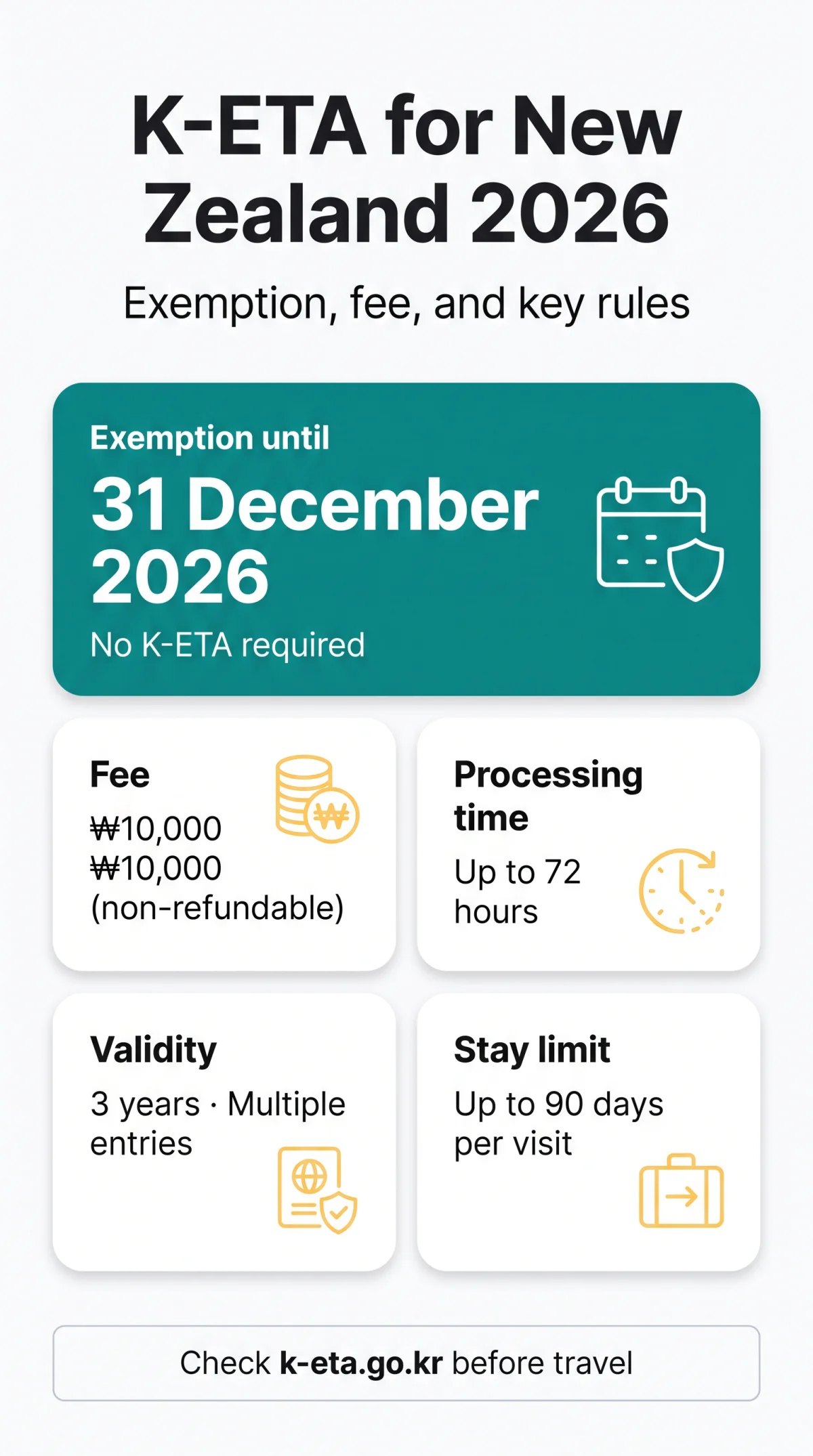
New Zealand passport holders are exempt from K-ETA until 31 December 2026. Voluntary fee: ₩10,000 (~NZD $11); processing ≤72 hours; validity 3 years with multiple entries.
What Is the K-ETA and Do New Zealand Citizens Need It in 2026?
The K-ETA (Korea Electronic Travel Authorization) for New Zealand citizens is an online pre-screening layer on top of existing visa-free access to South Korea. It is not a visa, and final admission rests with the Korea Immigration Service officer at the port of entry.
As of 2026, New Zealand is one of 22 countries covered by a temporary exemption extension, confirmed by the k-eta.go.kr portal and Visit Korea. New Zealand passport holders may travel from New Zealand to South Korea under K-ETA rules without obtaining prior authorisation through 31 December 2026. The exemption applies to tourism and short-term visits only; those travelling for work or study should verify separate visa requirements.
Decision guide for New Zealand citizens:
- Hold a New Zealand passport? You are exempt from K-ETA until 31 December 2026.
- Want to skip the arrival card at immigration? Apply voluntarily for a K-ETA.
- Already hold a valid K-ETA? No action needed; use it for arrival card exemption.
- Travelling after 31 December 2026? Check k-eta.go.kr for possible further extension or new requirements.
The permitted visa-free stay remains up to 90 days per visit, regardless of whether a K-ETA is held. Voluntary application provides the benefit of arrival card exemption at Korean immigration.
K-ETA Fees for New Zealand Passport Holders
The K-ETA for New Zealand citizens carries a government fee of ₩10,000 (≈ USD $7-8 / NZD $11), payable via the k-eta.go.kr portal at submission. For a full breakdown of K-ETA costs in multiple currencies, see our dedicated fee guide. An online payment surcharge may apply separately. The fee is non-refundable, even if the application is denied.
| Application Channel | Fee | Notes |
|---|---|---|
| Government portal (k-eta.go.kr) | ₩10,000 (≈ USD $7-8) | Direct application; non-refundable |
| Third-party (Visagenius) | USD $40 | Commercial markup over government fee |
| Third-party (Sherpa) | USD $94.29 | Commercial markup over government fee |
Only k-eta.go.kr is the government application portal. Third-party markups reach 500-1,200% for the identical process. Beware of phishing sites and fraudulent agencies posing as authorised operators. If you encounter a 3DS error during payment, try a different card or contact your bank to enable 3D Secure authentication.
Documents You Need for a K-ETA Application (New Zealand Citizens)
The K-ETA for New Zealand citizens requires the following documents and information, which are covered in detail in our complete K-ETA documents checklist:
- Valid New Zealand passport with biometric page scan uploaded during application
- Digital passport-style photo in JPG format, under 100 KB, plain background
- Personal details: full name, date of birth, nationality, occupation, parent names
- Travel information: flight and accommodation details
- Declaration: criminal history and infectious disease status
Common photo-rejection causes include shadows on the face, wearing glasses, wrong dimensions, and low-resolution scans. Make sure your image meets the K-ETA digital photo upload specifications before submitting. Use a photo resizing tool to ensure the file stays under 100 KB before uploading. Self-employed applicants should enter their business name in the employer field. Accommodation proof can be a hotel booking or invitation letter.
How to Apply for a K-ETA: Step-by-Step Guide and Processing Times
Although New Zealand citizens are exempt from K-ETA until 31 December 2026, if you choose to apply, the authorization must be obtained before boarding your flight or ship. The K-ETA for New Zealand citizens requires a 7-step online process at k-eta.go.kr:

Agree to Terms and Conditions
Accept the portal’s terms before proceeding.
Verify your email address
Gmail users may experience delivery delays per a k-eta.go.kr notice dated 13 March 2026; use Outlook or Yahoo as an alternative.
Enter passport information
Upload the biometric page scan of your passport.
Enter application information
Include personal and travel details.
Check all information for accuracy
Review every field before submitting.
Make payment of ₩10,000
Pay the non-refundable government fee via the portal.
Application complete
Approval generally issued within 72 hours.
Processing time for the K-ETA for New Zealand citizens is generally within 72 hours, with no expedited or urgent service available. For more detail on expected wait times and when to submit, read our guide on K-ETA processing times and validity. Applications are reviewed in order received and may exceed 72 hours during high-volume periods. To check status without an account, use your passport number and date of birth on the portal. Each traveller, including minors, requires a separate application. For inquiries, the K-ETA Center (02-2666-0463) does not provide telephone or face-to-face consultations; use the online inquiry page instead. The Immigration Contact Center (+82-1345) operates weekdays 09:00-22:00.
K-ETA Validity, Entry Rules, and Renewal for New Zealand Citizens
The K-ETA for New Zealand citizens is valid for 3 years from the approval date, or until the linked passport expires, whichever comes first. For example, if your K-ETA is approved in January 2026 and your passport expires in June 2028, the K-ETA expires in June 2028. It grants multiple entries within this period but does not extend the 90-day visa-free stay limit per visit.
If your travel plans change after approval, use the [Update Travel Information] page on the K-ETA website to update accompanying persons or itinerary details. Failure to update may result in entry denial or other disadvantages. A new application is required if your passport is reissued, your criminal record changes, or infectious disease information updates.
At Korean Immigration: What New Zealand K-ETA Holders Should Expect
Holders of a valid K-ETA for New Zealand citizens are exempt from submitting the arrival card upon entering the Republic of Korea. Learn more about the South Korea e-Arrival Card and how it works for travellers. Present your New Zealand passport at the immigration counter; the officer will verify your K-ETA status electronically.
Immigration officers may request proof of funds, accommodation details, and a return or onward ticket. Have booking confirmations accessible. Typical processing at Incheon International Airport takes 15-30 minutes depending on queue length. Automated gates may be available for eligible passport holders.
Dual NZ-South Korean citizens must enter South Korea on a Korean passport; K-ETA does not apply. If you hold both nationalities, verify entry requirements with the Embassy of the Republic of Korea in Wellington before travel.
Common K-ETA Application Mistakes, Rejection, and Re-Application for New Zealand Citizens
The most frequent K-ETA for New Zealand citizens rejection causes and their fixes are covered in our K-ETA application error troubleshooting guide:
| Problem | Cause | Fix |
|---|---|---|
| Photo rejected | File over 100 KB, shadows, glasses | Resize to under 100 KB; plain background; remove glasses |
| Name-entry error | Full name entered in surname field after passport scan | Check name order matches passport biometric page exactly |
| Payment failure | 3DS authentication error | Use a 3DS-enabled card; contact bank if needed |
| False information | Inaccurate criminal or health declaration | Submit a new application with correct details |
Providing inaccurate details can result in refusal or cancellation of approval, with entry restrictions under Korean law. The ₩10,000 fee is non-refundable on denial. If you discover a typo before a decision is issued, contact the K-ETA Center via the online inquiry page to request correction.
Age-based application exemptions: Individuals aged 17 or younger or 65 or older on the date of entry may be exempt from the K-ETA application requirement. Official passport holders, ABTC cardholders, and transit passengers are also exempt.
Do not confuse the K-ETA with the NZeTA. The NZeTA (New Zealand Electronic Travel Authority) applies to entering New Zealand: NZD $17 fee, 2-year validity, 3-month stay. The K-ETA applies exclusively to South Korea entry.
Featured snippet: As of 2026, New Zealand passport holders are exempt from K-ETA requirements when entering South Korea. The temporary exemption runs until 31 December 2026. NZ citizens may still apply voluntarily. The fee is ₩10,000 (~NZD $11), processing takes up to 72 hours, and the K-ETA is valid for 3 years with multiple entries.
FAQ: K-ETA for New Zealand Citizens
How much does a K-ETA cost for New Zealand citizens in 2026?
The government fee is ₩10,000 (≈ NZD $11 / USD $7-8) via k-eta.go.kr, non-refundable even if denied. Third-party services charge $40-$94+ for the same application.
Do New Zealand citizens still need a K-ETA to enter South Korea?
No. NZ citizens are exempt until 31 December 2026. Voluntary application is permitted and provides arrival card exemption at immigration.
How long does K-ETA approval take for NZ passport holders?
Generally within 72 hours; many approved in under 24 hours. No expedited service exists. Apply at least 72 hours before departure.
Can I apply for a K-ETA at the airport before my flight?
Not recommended. Apply at least 72 hours before departure via k-eta.go.kr. The K-ETA must be approved before boarding.
Is the K-ETA fee refundable if my application is denied?
No. The ₩10,000 fee is strictly non-refundable under all circumstances, including rejection. The fee covers the assessment process, not the outcome.
How long can I stay in South Korea with a K-ETA as a NZ citizen?
Up to 90 days per visit under the visa-free arrangement. The K-ETA itself is valid for 3 years with multiple entries but does not extend the stay limit.
Can I use a third-party service to apply for K-ETA?
You can, but they charge $40-$94+ for the same application available for ~$7-8 on the official portal k-eta.go.kr. Markups reach 500-1,200%.
What happens if my passport expires after I receive my K-ETA?
You must reapply with your new passport. The K-ETA linked to the expired passport is no longer valid. A new application is also required if your criminal record or infectious disease information changes.
Do children need their own K-ETA to travel to South Korea?
Yes, each traveller including minors requires a separate K-ETA application if applying voluntarily. However, individuals aged 17 or younger on the date of entry may be eligible for an application exemption.
Do I need to fill in an arrival card if I have a K-ETA?
No. A valid K-ETA exempts you from the arrival card requirement at Korean immigration. This is the key benefit of voluntary application for exempt NZ citizens.
Disclaimer: This article is for informational purposes only and does not constitute legal or immigration advice. Immigration rules change frequently; always verify current requirements on the k-eta.go.kr portal or with the nearest Korean embassy before booking travel. We do not receive commissions from any third-party visa agency mentioned in this article.