
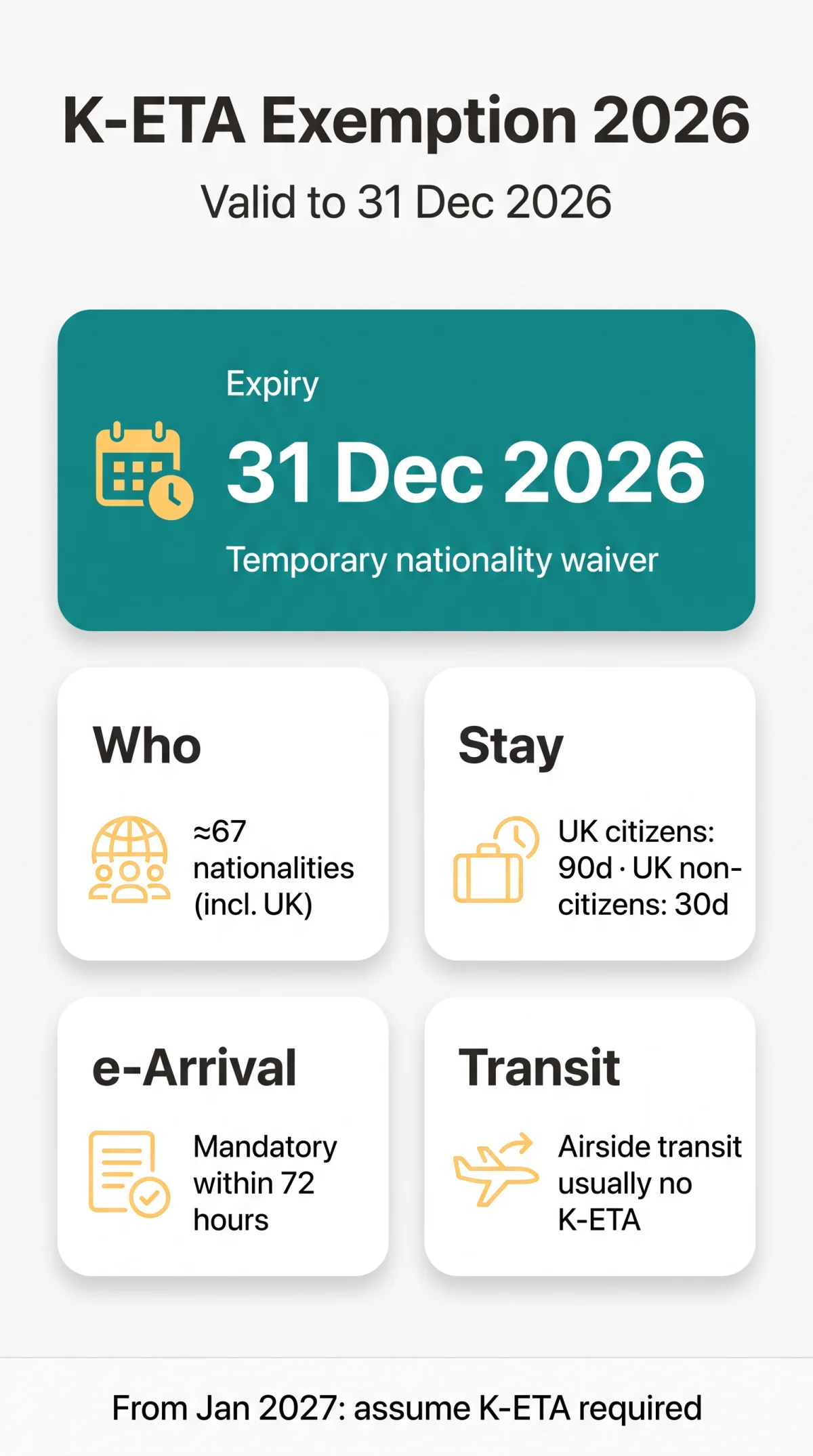
In 2026, approximately 67 nationalities, including all UK citizens, are temporarily exempt from K-ETA under a waiver valid through 31 December 2026. There is no blanket age exemption, and the 52-hour transit rule may allow short layovers without K-ETA.
Last updated: 15 September 2026. Next review: November 2026. Compiled by the editorial team from Korea Immigration Service publications, the K-ETA portal (k-eta.go.kr), and gov.uk travel advisories. Changes in this update: added Indonesia group policy from 25 Feb 2026; clarified that the “52-hour rule” is not a confirmed designation in Korea Immigration Service publications; updated e-Arrival Card link; added FAQ for passport renewal and emergency entry.
Even with the K-ETA exemption, travellers must complete the mandatory e-Arrival Card within 72 hours before arrival. Holders of a valid K-ETA, even voluntary, are exempt from this requirement.
K-ETA in 2026: Overview and Rules for UK Citizens
K-ETA (Korea Electronic Travel Authorization) is a mandatory electronic travel authorisation for visa-free visitors to South Korea, not a visa. The temporary exemption introduced in April 2023 by the Ministry of Justice has been extended and remains valid through 31 December 2026.
The K-ETA exemption countries list for 2026 includes the United Kingdom, allowing British citizens to enter South Korea visa-free for up to 90 days. Other UK nationals may stay up to 30 days; both groups are covered by the waiver through 31 December 2026. The UK-South Korea visa exemption agreement has been in effect since 19 December 1969.
Travellers on the K-ETA exemption countries list must present a valid passport (valid until after the departure date; a 6-month buffer is recommended to avoid airline boarding issues) and an onward or return ticket. Employment on visa-free entry is illegal in any capacity, including teaching. For non-tourism purposes such as work or study, contact the South Korean Embassy in the UK to verify visa requirements. Returning British dual nationals need a valid British passport or certificate of entitlement.
Complete List of K-ETA Exemption Countries in 2026
The K-ETA exemption countries list for 2026 covers approximately 67 nationalities across six continents, all exempt through 31 December 2026, with special conditions for Kuwait, Russia, China, and Indonesia. This list removes the pre-screening layer for eligible nationals who already hold visa-free entry rights.
| Continent | Countries & Territories | Max Visa-Free Stay | Exempt to 31 Dec 2026 | Special Conditions |
|---|---|---|---|---|
| Asia-Pacific | Japan, Taiwan, Hong Kong, Macao, Singapore, Brunei, Thailand, Malaysia, China, Indonesia | – | Yes | China: tour groups of 3+ people, up to 15 days, through 31 Dec 2026. Indonesia: tour group visa-free policy announced 25 Feb 2026. |
| Americas | United States (incl. Guam), Canada, Mexico, Brazil, Argentina, Chile, Colombia, Costa Rica, Dominica, Dominican Republic, Ecuador, El Salvador, Grenada, Guatemala, Haiti, Jamaica, Nicaragua, Panama, Peru, Saint Kitts and Nevis, Saint Lucia, Saint Vincent and the Grenadines, Trinidad and Tobago, Uruguay, Venezuela, Suriname, Antigua and Barbuda, Bahamas, Barbados, Guyana, Honduras, Paraguay | – | Yes | – |
| Europe | United Kingdom, Germany, France, Italy, Netherlands, Austria, Belgium, Cyprus, Greece, Luxembourg, Iceland, Liechtenstein, Norway, Sweden, Switzerland, Denmark, Finland, Spain, Portugal, Ireland, Poland, Hungary, Czech Republic, Estonia, Latvia, Lithuania, Malta, Bulgaria, Romania, Slovakia, Croatia, Serbia, Turkey, Albania, Andorra, Bosnia and Herzegovina, Monaco, Montenegro, San Marino, Vatican City, Russia | Up to 90 days (UK citizens) | Yes | UK non-citizen nationals: up to 30 days. Russia: 60 days plus 90 days within any 180-day period. |
| Oceania | Australia, New Zealand, Fiji, Kiribati, Marshall Islands, Micronesia, Nauru, New Caledonia, Palau, Samoa, Solomon Islands, Tonga, Tuvalu | – | Yes | – |
| Africa | South Africa, Botswana, Eswatini, Lesotho, Mauritius, Morocco, Seychelles, Tunisia | – | Yes | – |
| Middle East | Bahrain, Israel, Kuwait, Oman, Qatar, Saudi Arabia, United Arab Emirates | – | Yes | Kuwait: 90 days within any 180-day period. |
The 52-Hour Transit Rule and Layover Exemptions
Passengers transiting through Incheon or Gimpo for short layovers with a confirmed onward ticket may pass without K-ETA, subject to staying airside or meeting specific transit criteria.

The term “52-hour rule” is not found in Korea Immigration Service publications as of September 2026 and should be treated as unverified. What is confirmed: airside direct transit at Incheon and Gimpo generally does not require K-ETA, provided passengers remain within the international transit zone. Example: a London to Tokyo flight via Incheon, staying airside with a confirmed onward ticket, generally does not require K-ETA.
Hold a confirmed onward ticket
Departing within the transit window
Remain airside
Without clearing South Korean immigration or changing terminals
Carry no checked luggage
Requiring collection and re-check at the transit airport
Transit Without Visa (TWOV) provisions are distinct from the K-ETA exemption countries waiver: TWOV governs whether a passenger may enter Korea during a layover, whereas airside transit avoids Korean Immigration entirely. Verify your status on the K-ETA portal before departure.
Age-Based K-ETA Exemptions for Minors and Seniors
No blanket age-based K-ETA exemption exists. According to the K-ETA portal FAQ [Q58] (published 11 June 2026, retrieved 15 September 2026 from k-eta.go.kr), all travellers must either hold a valid K-ETA, qualify under a separate exemption category, or be covered by the temporary nationality-based waiver. The K-ETA exemption countries list governs eligibility through nationality alone, not through age thresholds.
| Age Bracket | Exempt by Age Alone? | Covered by Temporary Nationality Waiver? |
|---|---|---|
| Under 18 (minors) | No | Yes, if nationality is on the exempt list |
| 18-64 (adults) | No | Yes, if nationality is on the exempt list |
| 65+ (seniors) | No | Yes, if nationality is on the exempt list |
When the waiver expires on 31 December 2026, travellers from K-ETA exemption countries will need to apply, including children and seniors.
When Do K-ETA Exemptions End? e-Arrival Card & 2027 Outlook
The current K-ETA exemption expires on 31 December 2026, and even travellers on the K-ETA exemption countries list must complete the mandatory e-Arrival Card before arriving in South Korea.
The waiver, introduced in April 2023 by the Ministry of Justice, was extended to 31 December 2026 after the 10th National Tourism Strategy Meeting chaired by Prime Minister Kim Min-seok. The extension supports the “Visit Korea Year” initiative, targeting 30 million international tourists by 2030.
From 1 January 2026, the e-Arrival Card became mandatory for all travellers, including those on the K-ETA exemption countries list. It is free, submitted online at e-arrivalcard.go.kr within 72 hours before arrival. Paper arrival cards remain available at immigration as a fallback. Travellers holding a valid K-ETA are exempt from the e-Arrival Card requirement.
If you are booking travel for January 2027 onward, assume K-ETA will be required. Monitor the K-ETA portal for updates.
Who Must Apply for K-ETA? Fees, Processing and Voluntary Applications
Exempt travellers bypass the application process through 31 December 2026; others must obtain K-ETA approval. Nationals of countries without visa-free access to South Korea must apply before departure. K-ETA does not guarantee entry; the final decision rests with the immigration officer at the port of entry.
Apply only at the K-ETA portal (k-eta.go.kr). gov.uk warns that non-official application sites are generally scams. The application fee is 10,000 KRW (approximately $7-8 USD / £6) and remains non-refundable, even if the authorisation is denied. Processing typically takes up to 72 hours, with no expedited service available. Once granted, the authorisation allows multiple entries over its 3-year validity period.
| Scheme | Country | Validity | Temporary Nationality Waiver? |
|---|---|---|---|
| K-ETA | South Korea | 3 years | Yes, through 31 Dec 2026 |
| ESTA | United States | 2 years | No |
| eTA | Canada | 5 years | No |
Even those on the K-ETA exemption countries list may benefit from a voluntary application. Approved applicants skip the mandatory e-Arrival Card and gain access to Smart Entry Service (SES) automated immigration gates at major airports. Tip: a voluntary K-ETA grants SES access, cutting immigration queue time from approximately 30 minutes to under 2 minutes at Incheon Terminal 1.
Special Cases: Diplomatic Passports, APEC Cards, Jeju & Dual Nationals
Diplomatic, Official and Service Passport Holders
Holders of diplomatic, official, or service passports may be exempt from K-ETA under bilateral agreements between South Korea and their country of citizenship. These K-ETA exemptions operate independently of the temporary nationality-based waiver. Travellers in this category should contact the South Korean Ministry of Foreign Affairs to confirm whether their specific bilateral agreement includes a K-ETA waiver.
APEC Business Travel Card (ABTC) Holders
Travellers holding an APEC Business Travel Card with South Korea clearance may have their K-ETA requirement waived. This pathway is distinct from the K-ETA exemption countries list and applies specifically to cardholders with verified Korea clearance. ABTC holders should confirm their status before departure, as K-ETA compliance remains mandatory without confirmed clearance.
Jeju Province – Separate Entry Rules
Jeju Province operates an autonomous 30-day visa-free regime for direct arrivals. Tourists flying directly to Jeju may bypass K-ETA entirely, though mainland transit still requires K-ETA compliance for non-exempt nationalities.
Dual Citizens and Korean Passport Holders
Dual citizens entering South Korea on a Republic of Korea passport are not subject to K-ETA and proceed directly to immigration without K-ETA approval.
Frequently Asked Questions (FAQ)
Do UK citizens need K-ETA for South Korea in 2026?
No, UK citizens holding a full British citizen passport are exempt from K-ETA through 31 December 2026, allowing a visa-free stay of up to 90 days. Must hold a valid passport and onward or return ticket, plus complete the e-Arrival Card before arrival.
Which countries are exempt from K-ETA in 2026?
Approximately 67 nationalities across six continents are exempt through 31 December 2026, including the UK, USA, Japan, Canada, Australia, and major EU states. The exemption applies only to nationals who already enjoy visa-free entry to South Korea.
What is the 52-hour transit rule for K-ETA exemption?
The term “52-hour rule” is not found in Korea Immigration Service publications as of 2026. However, passengers transiting through Incheon or Gimpo who remain airside with a confirmed onward ticket generally do not require K-ETA. Transit Without Visa provisions may also apply to certain nationalities.
Are children under 17 exempt from K-ETA?
No blanket age-based exemption exists for minors. Per the K-ETA portal FAQ [Q58] published 11 June 2026, all travellers must obtain K-ETA or qualify under the temporary nationality-based exemption. Children from exempt nationalities are covered by the same waiver through 31 December 2026.
Are seniors over 65 exempt from K-ETA?
No blanket age-based exemption exists for seniors over 65. The K-ETA portal FAQ confirms all travellers must either hold a valid K-ETA or be covered by the temporary nationality-based exemption. Seniors from exempt nationalities are covered through 31 December 2026.
When does the K-ETA exemption end?
The current temporary K-ETA exemption expires on 31 December 2026 (Korean Standard Time). As of September 2026, no announcement has been made regarding further extensions, so travellers booking for January 2027 should prepare to apply.
Do I need K-ETA if I’m transiting through Incheon Airport?
Short airside transits at Incheon or Gimpo generally do not require K-ETA if you remain in the international transit zone with a confirmed onward ticket. If you clear immigration for a layover, the requirement becomes nationality-dependent.
Will K-ETA exemptions continue in 2027?
As of September 2026, there is no announcement regarding an extension beyond 31 December 2026. If booking for January 2027 or later, assume K-ETA will be required. Monitor the K-ETA portal for updates.
Do I need K-ETA for Jeju Island?
Jeju Province operates its own autonomous 30-day visa-free regime. Direct arrivals to Jeju may bypass K-ETA entirely. However, if transiting through mainland South Korea, standard K-ETA compliance is required for non-exempt nationalities.
Can I get an emergency K-ETA exemption for humanitarian travel?
Contact the K-ETA Center at 02-2666-0463 or submit an online inquiry at k-eta.go.kr/portal/board/viewemailcontact.do. The K-ETA Center does not provide telephone or face-to-face consultations in principle.
Do I need a new K-ETA if I renew my passport?
Yes, K-ETA is linked to your passport number. Renewing your passport, or any change in name, gender, or nationality, requires a new application. The 10,000 KRW fee is non-refundable.