
K-ETA South Korea is a mandatory digital pre-entry permit for nationals of 112 visa-free countries visiting for short-term stays. British citizens are temporarily exempt from K-ETA until 31 December 2026. All other eligible travellers must apply online at k-eta.go.kr before departure.
This pre-screening layer for tourism, business, or transit is managed by the Korea Immigration Service under the Ministry of Justice. K-ETA is not a visa but a mandatory requirement for boarding your flight or ship.
While the temporary exemption for 22 designated countries, including the United Kingdom, remains active until the end of 2026, travellers must still meet other South Korea entry requirements. These include presenting a valid passport and potentially completing the e-Arrival Card or Q-Code health declaration, depending on your travel circumstances.
This is an independent travel information guide, not an official government source. Entry rules may change. Always verify with the official K-ETA portal at k-eta.go.kr and UK government travel advice (gov.uk) before departure. Information last verified on 15 September 2026.
What Is K-ETA and How Does It Work in 2026?
K-ETA is a mandatory digital pre-screening system that visa-free nationals must complete online before boarding any flight or ship to South Korea. The Korea Electronic Travel Authorization is issued by the Korea Immigration Service (Ministry of Justice, Republic of Korea) for nationals of 112 visa-free countries visiting for short-term tourism, business, or transit.
Once approved, K-ETA is valid for 3 years from the date of approval or until the linked passport expires, whichever comes first, and permits multiple entries during that period. Applications are submitted online at k-eta.go.kr, with standard processing typically completed within 72 hours.
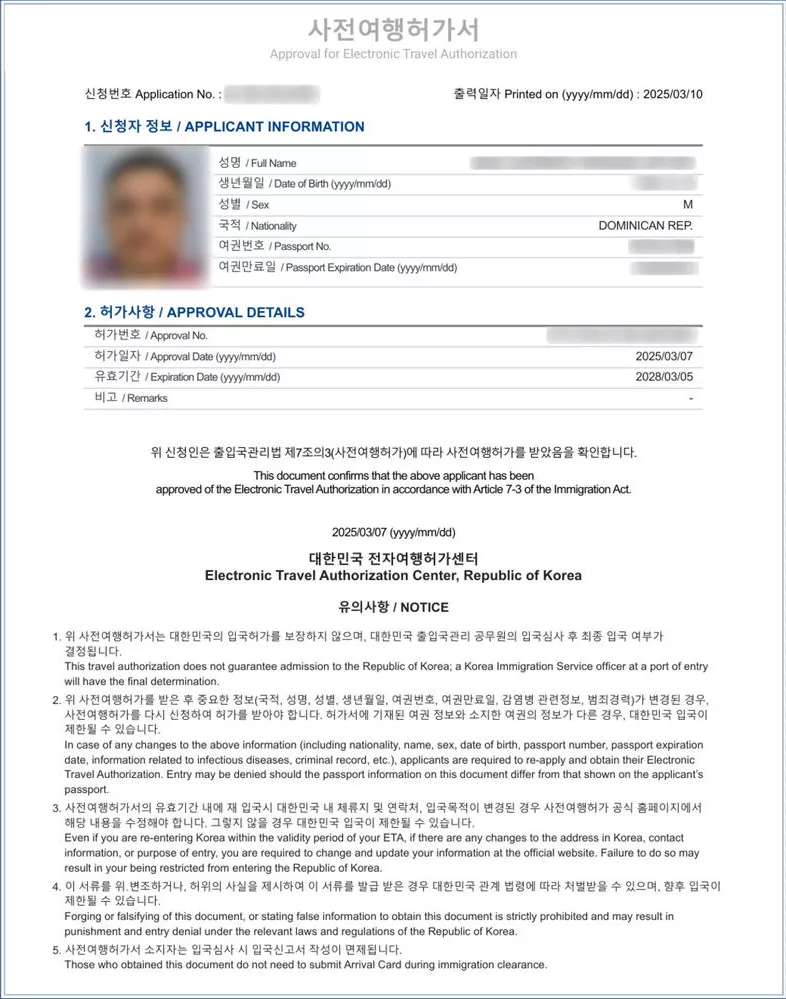
South Korea also operates two separate digital systems: the e-Arrival Card (a digital arrival declaration) and Q-Code (a quarantine health declaration). Holding a Korea Electronic Travel Authorization does not exempt travellers from these systems, which serve different functions.
K-ETA Validity, Multiple Entries and Passport Rules
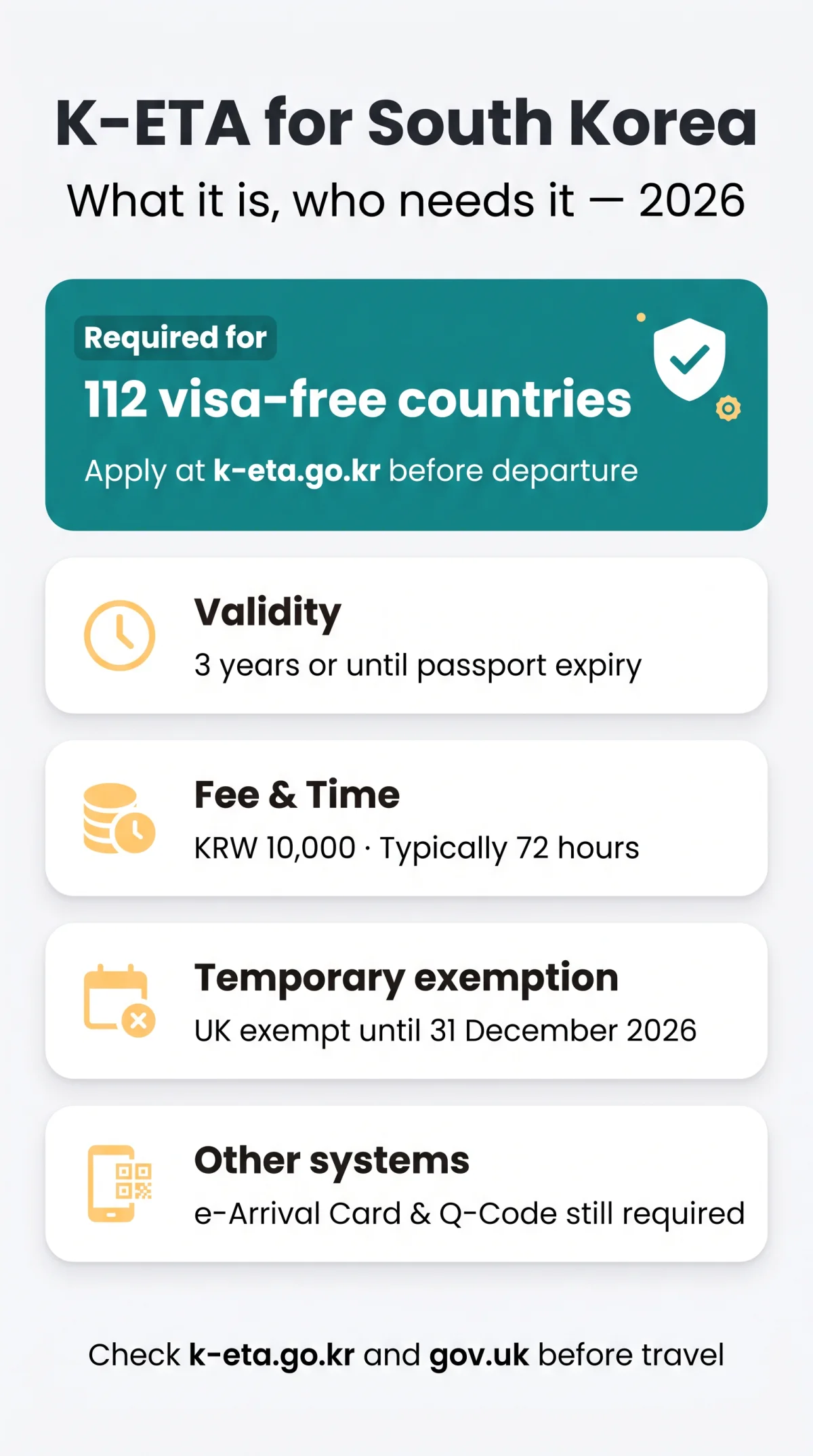
K-ETA is valid for 3 years from approval or until the passport expires, permitting unlimited entries during that period.
- 3-year validity: K-ETA remains valid for 3 years from the date of approval or until the linked passport expires, whichever comes first.
- Multiple entries: K-ETA allows multiple entries into South Korea during the validity period, with no limit on the number of trips.
- Ordinary passport required: Applicants must hold an ordinary passport with an expiry date after the intended departure from South Korea; diplomatic and official passport holders are exempt.
- Biographic page scan: A colour scan or photo of the passport biographic page must be uploaded during the online application.
- Photo specifications: The application photo must be taken within the last 6 months, measure 3.5 × 4.5 cm, feature a white background, be in colour, and show a front-facing headshot with no glasses or other accessories; hijab is permitted.
- Passport renewal invalidates K-ETA: If the passport linked to an approved K-ETA is replaced, a new application must be submitted using the new passport details.
Who Needs a K-ETA to Enter South Korea in 2026?
K-ETA is required for nationals of 112 visa-free countries before departure, but final admission rests with the immigration officer at the port of entry.
K-ETA applies to 112 visa-free nationalities: 66 under the Visa-Waiver (B-1) and 46 under Designated Visa-Free Entry (B-2). Approved K-ETA is mandatory for boarding, but does not guarantee entry; the final decision rests with the immigration officer at the port of entry.
Three assessment outcomes are possible. “OK” means the traveller may board and is exempt from submitting an e-Arrival Card. “Selectee” permits boarding but requires an in-depth interview on arrival. “Not OK” denies boarding entirely.
K-ETA does not apply to holders of diplomatic or official passports, holders of valid Korean visas, or residents returning with re-entry permits. Certain nationalities and age categories are also exempt under temporary measures in place during 2026.
K-ETA Exemptions in 2026: Countries, Ages and Special Categories
Citizens of 22 countries including the UK are exempt from K-ETA until 31 December 2026, alongside travellers aged under 17 or 65 and over.
K-ETA does not apply to nationals of 22 designated countries and regions during a temporary exemption period running through 31 December 2026. British nationals travelling visa-free are confirmed exempt under this scheme, alongside citizens of the United States, Canada, Japan, Australia, New Zealand, Austria, Singapore and Macau. The full 22-country exemption list should be verified against the K-ETA portal at k-eta.go.kr before travel, as country designations may change.
| Exempt country / region | UK? |
|---|---|
| United Kingdom | ✅ |
| United States | |
| Canada | |
| Japan | |
| Australia | |
| New Zealand | |
| Austria | |
| Singapore | |
| Macau | |
| + 13 other designated countries |
Separately, K-ETA exemptions apply by age category. Since 3 July 2023, travellers aged 17 and under and those aged 65 years or above have not been required to obtain K-ETA before departure. Holders of diplomatic or official government-issued passports are also exempt, as are crew members operating international routes into South Korea.
Exemption from K-ETA does not remove other entry obligations. British visitors must still satisfy passport validity rules, submit an e-Arrival Card unless covered by a separate exemption, and comply with Q-Code health screening requirements where applicable.
UK Citizens Travelling to South Korea in 2026: Entry Pathway
British passport holders are currently exempt from K-ETA until 31 December 2026 and can enter visa-free for up to 90 days.
Passport validity
Your British passport expiry date must fall after your departure date from South Korea. A lost or stolen passport will result in denied entry.
Visa-free entry
British citizens may stay up to 90 days for tourism or short-term business. Employment on visa-free entry, including teaching, is illegal.
K-ETA
K-ETA is temporarily waived for UK nationals until 31 December 2026. No application is needed during this window; verify status on the k-eta.go.kr portal before travel in case the exemption changes.
e-Arrival Card
Unless you hold a valid K-ETA with “OK” or “Selectee” status, submit the free e-Arrival Card online within 72 hours before arrival at e-arrivalcard.go.kr.
Q-Code
The UK is designated a Quarantine Inspection Required Area. Travellers from the UK may need to complete the Q-Code health declaration up to 7 days before arrival; non-compliance can incur a fine of up to KRW 10 million.
Documents at the border
Carry your passport, an onward or return ticket, proof of accommodation, and evidence of sufficient funds.
K-ETA vs e-Arrival Card vs Q-Code: Which Digital Systems Do You Need?
K-ETA, the e-Arrival Card, and Q-Code are three separate South Korean digital entry systems – having one does not exempt travellers from the others.
| System | Purpose | Cost | When to Submit | UK Traveller Status |
|---|---|---|---|---|
| K-ETA (Korea Electronic Travel Authorization) | Pre-departure travel authorisation for visa-free nationals | KRW 10,000 (~£6) | At least 72 hours before departure | Temporarily exempt until 31 December 2026 |
| e-Arrival Card (K-EAC) | Digital arrival declaration replacing paper card | Free | Within 72 hours before arrival | Required unless K-ETA status is OK or Selectee |
| Q-Code (Quarantine Pre-Entry System) | Health/quarantine declaration for arrivals from designated areas | Free | Up to 7 days before arrival | UK is a Quarantine Inspection Required Area |
K-ETA approval with OK or Selectee status exempts the holder from submitting an e-Arrival Card, but does not replace Q-Code. Travellers arriving from the United Kingdom must still complete Q-Code or submit a paper health questionnaire on arrival, with non-compliance carrying a fine of up to KRW 10 million. The e-Arrival Card is submitted at e-arrivalcard.go.kr, while K-ETA applications are processed through k-eta.go.kr.
Applying as a Dual National: Which Passport Should You Use?
Apply using the passport you will present at the Korean border – K-ETA is linked to one passport number and both documents must match.
K-ETA is tied to a single passport number, so the travel document used in the application must be the same one shown at airline check-in and Korean border control. If one of your passports qualifies for the temporary K-ETA exemption and the other does not, submit a K-ETA application using the passport that requires authorisation, then travel on that document.
Carry both passports when travelling with dual nationality. If you hold Korean dual nationality, consult the Embassy of the Republic of Korea in London for guidance on entry obligations, as K-ETA rules may not apply in the standard way.
K-ETA Cost, Processing Time and Payment Methods
K-ETA costs KRW 10,000 (approximately £6), is non-refundable regardless of outcome, and is typically processed within 72 hours.
The K-ETA application fee is strictly non-refundable whether the assessment result is “OK,” “Selectee,” or “Not OK.” Applicants pay the KRW 10,000 charge during the online process at k-eta.go.kr, and no refund mechanism exists for denied or duplicate submissions.
K-ETA applications are generally processed within 72 hours. A fast-track outcome can be issued within 30 minutes when no issues are flagged, though cases requiring further review may take up to 24 hours. Travellers are advised to apply at least 72 hours before departure.
K-ETA accepts Visa, Mastercard, JCB, and American Express. If payment fails, contact your bank to enable 3-D Secure authentication and international transactions.
How to Apply for K-ETA South Korea Online – Step by Step
K-ETA applications are submitted exclusively at k-eta.go.kr. For a complete walkthrough, read our step-by-step K-ETA application guide. Third-party sites charging inflated fees are scams, according to UK government travel advice (gov.uk).

Accept the Terms and Conditions
Review and agree to the K-ETA terms before proceeding.
Verify your email address
Confirm your email to activate your application.
Enter passport information
Provide name, date of birth, nationality, gender, occupation – matching the passport exactly.
Upload a colour scan of the passport biographic page
Ensure the scan is clear and in colour.
Upload a K-ETA-compliant photo
Taken within the last 6 months, 3.5 × 4.5 cm, white background, colour, front-facing, no glasses.
Enter travel details
Intended arrival date, flight number, accommodation in South Korea.
Complete criminal and health declarations
Answer all declaration questions truthfully.
Review all information
Errors may cause delays or denial – check every field carefully.
Pay the KRW 10,000 fee
By Visa, Mastercard, JCB or American Express.
Receive confirmation by email
Check your K-ETA approval status online using the application number.
Korean border control generally accepts K-ETA approval shown on a mobile device, though carrying a printed copy is strongly recommended. Member accounts on the Korea Electronic Travel Authorization portal allow viewing all application details at once.
Understanding Your K-ETA Assessment Result and Denial Recovery
K-ETA (Korea Electronic Travel Authorization) applications receive one of three outcomes, delivered by email from the Korea Immigration Service. Each result carries distinct consequences for your ability to travel to South Korea in 2026.
“OK” means you are approved to board your flight or vessel. Travellers with this outcome are also exempt from submitting the e-Arrival Card, since their pre-screening has already cleared them through that step.
“Selectee” means you may still board, but you will undergo an in-depth interview with an immigration officer at the port of entry before a final admission decision is made. Expect additional questioning about your travel purpose, accommodation, return ticket, and financial means, typically lasting 15-45 minutes. Selectee-status holders are likewise exempt from the e-Arrival Card.
“Not OK” means you cannot board any flight or ship bound for South Korea. The K-ETA system does not provide an administrative appeal process for denied applications. The fallback pathway is to apply for a standard Korean visa – C-3-1 for tourism or C-3-4 for business – through the Embassy of the Republic of Korea in London, referenced as the contact point for UK entry-requirement inquiries by gov.uk.
FAQ
Do I need K-ETA if I am transiting through South Korea without leaving the airport?
No. Passengers remaining in the international transit area at Incheon or Gimhae International Airport without passing through border control do not need K-ETA. You only need to apply for this electronic travel authorisation if you intend to pass through immigration and enter South Korea during your journey.
What happens if my K-ETA application is denied?
If you receive a “Not OK” result, you cannot board your flight or vessel bound for South Korea. There is no administrative appeal process described by the authorities. You must apply for a standard Korean visa, such as C-3-1 for tourism or C-3-4 for business, through the Embassy of the Republic of Korea in London.
Is the K-ETA fee refundable if my application is denied?
No, the KRW 10,000 application fee is strictly non-refundable regardless of the assessment outcome. Whether your application receives an “OK”, “Selectee”, or “Not OK” status, or if you mistakenly applied despite being eligible for an exemption, you will not receive a refund.
My passport has expired – is my K-ETA still valid?
No, your K-ETA is no longer valid. The authorisation is directly linked to your specific passport number. If you renew your passport or replace it for any reason, you must submit a completely new K-ETA application using your new passport details before travelling to South Korea.
Do I need a printed copy of my K-ETA or is a digital version sufficient?
Korean border control generally accepts K-ETA approval shown on a mobile device, such as a PDF or email confirmation. However, carrying a printed copy is strongly recommended in case of device battery failure or network issues at the airport.
Can I extend my 90-day visa-free stay once I am in South Korea?
Extensions may be possible at a local immigration office, subject to approval. If you need to extend your stay beyond the 90-day visa-free limit, contact the nearest Korean immigration branch by dialling 1345 domestically, or visit the Hi Korea portal for specific guidance on your situation.
Do children under 17 need a K-ETA?
No, travellers aged 17 and under are exempt from the K-ETA requirement. This age exemption has been effective since 3 July 2023. Additionally, seniors aged 65 years or above are also exempt from needing to acquire this electronic travel authorisation before their trip.
Is the Q-Code still required for UK travellers arriving in South Korea?
The UK is designated as a Quarantine Inspection Required Area. Travellers from the UK may need to complete the Q-Code health declaration up to 7 days before arrival, or submit a paper health questionnaire on arrival. Non-compliance can result in a fine of up to KRW 10 million. Verify current requirements on the Q-Code portal before departure, as designations may change.
What payment methods are accepted on the K-ETA website?
K-ETA accepts Visa, Mastercard, JCB, and American Express. If payment fails, contact your bank to enable 3-D Secure authentication and international transactions.
I have both a British and a Korean passport – which one should I use for K-ETA?
Apply using the passport you will present at the Korean border, as K-ETA is linked to one passport number. If you hold Korean dual nationality, consult the Embassy of the Republic of Korea in London for specific guidance on entry obligations, as K-ETA rules may not apply in the standard way.