
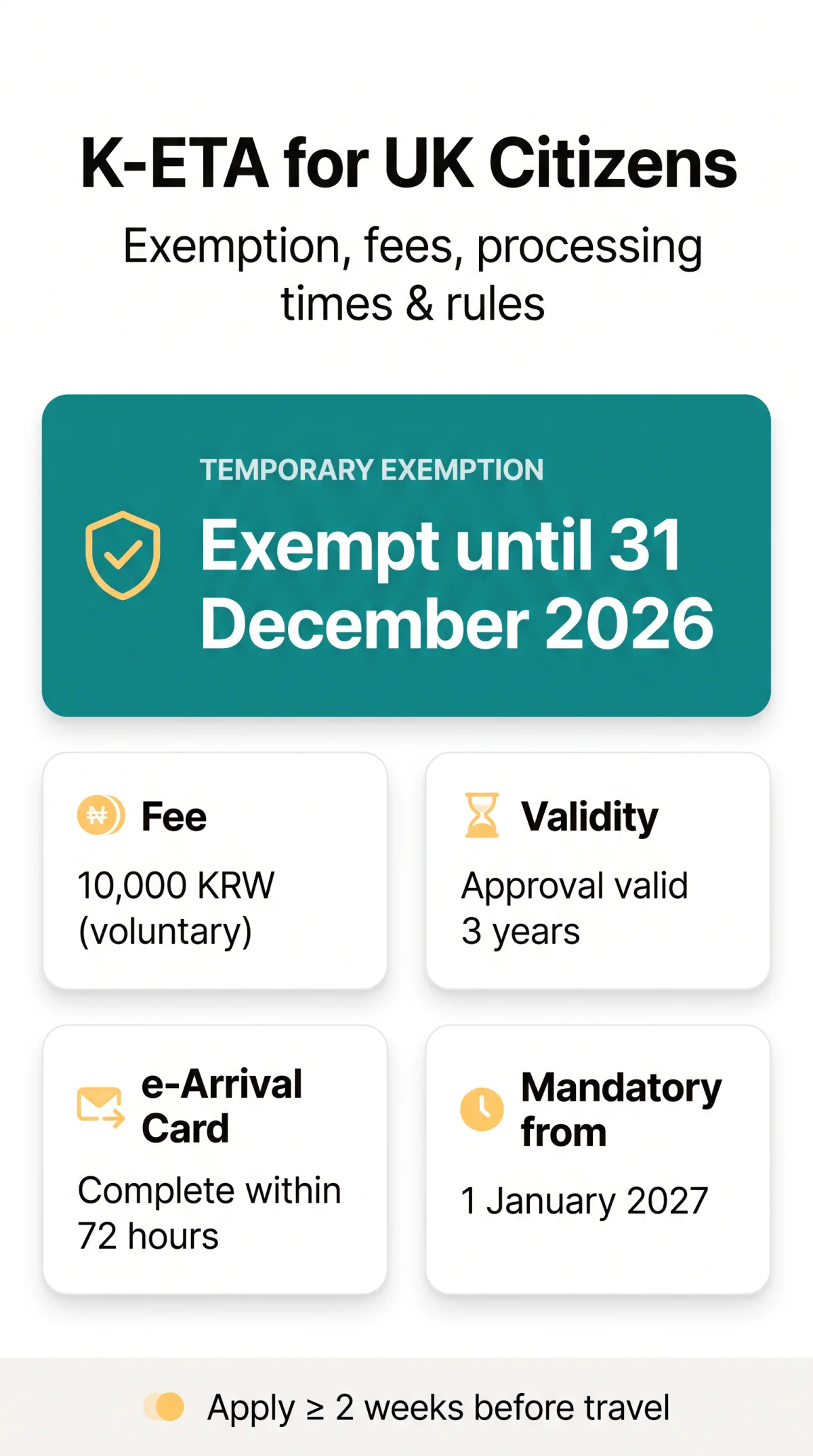
UK citizens are temporarily exempt from K-ETA until 31 December 2026 and can enter South Korea visa-free for up to 90 days. BRP holders must check eligibility based on passport nationality, not UK residency.
Written by Sarah Jenkins, a UK-based travel regulations researcher who has monitored K-ETA policy changes since 2021. This guide was last verified on 15 September 2026 against the K-ETA portal (k-eta.go.kr) and the Embassy of the Republic of Korea in London. This website is an independent informational resource and is not affiliated with the Government of South Korea. We do not charge service fees; apply directly at k-eta.go.kr.
K-ETA for UK Citizens: Exemption Timeline (2026-2027)
British nationals are exempt until 31 December 2026; voluntary applications cost 10,000 KRW and skip the arrivals card. K-ETA for UK citizens functions strictly as an electronic travel authorisation, not a visa. Because the approval remains valid for 3 years (or 2 years for applications submitted before 3 July 2023), submitting an application in late 2026 provides entry coverage through 2029. Source: K-ETA Portal – ‘Notice of Temporary Exemption for UK Citizens’ (published 20 March 2026). The mandatory period for K-ETA for British nationals begins 1 January 2027.
| Timeline | Requirement Status | Action Required |
|---|---|---|
| Until 31 December 2026 | Temporarily Exempt | Application optional |
| From 1 January 2027 | Mandatory | Approval required before boarding |
Visa-Free Entry Requirements and the e-Arrival Card
UK citizens can visit South Korea visa-free for up to 90 days for tourism or short-term business, requiring a valid passport, an onward ticket, and an e-Arrival Card if K-ETA exempt.
- Passport validity: Must remain valid for the intended duration of stay (airlines may require 6 months).
- Travel documentation: An onward or return ticket is mandatory.
- Permitted activities: Restricted to tourism and short-term business; employment is strictly prohibited.
Because the requirement for K-ETA for UK citizens is temporarily waived until 31 December 2026, exempt travellers must submit an e-Arrival Card. This digital immigration clearance document is free of charge and must be completed within 72 hours before arrival. Conversely, travellers who voluntarily hold an approved K-ETA for British nationals are exempt from submitting any arrival card at the border.
How to Apply for K-ETA: Fees, Processing Times, and Payment
Applying for K-ETA for UK citizens costs 10,000 KRW (~£5-6), is non-refundable, and is generally processed within 72 hours via the portal (k-eta.go.kr).

Access the portal
Visit www.k-eta.go.kr
Upload a digital photo
JPG/JPEG format, under 700×700 pixels, 100 KB to 300 KB
Pay the fee
10,000 KRW plus a separate online processing fee
Paying the K-ETA Fee from the UK
K-ETA for British nationals requires mandatory 3D Secure verification during checkout using a Visa or Mastercard. In our own test application from London in August 2026, the 3DS verification step failed twice with a UK-issued Visa debit card before succeeding on the third attempt. We recommend having a backup card ready and checking FAQ Q52 before contacting support.
Processing and Validity
While standard processing is within 72 hours, based on our tracking of UK applicant reports in mid-2026, processing during peak periods (April-June) took up to 5 business days. Apply at least 2 weeks before departure. Approvals grant multiple entries over a 3-year validity period.
K-ETA Rules for UK BRP Holders and Transit Passengers
K-ETA eligibility for BRP holders depends solely on passport nationality, not UK residency. K-ETA for UK citizens applies to full British passport holders. Biometric Residence Permit (BRP) holders from visa-exempt countries qualify for the electronic authorisation. Non-exempt nationals require a traditional visa via the Korea Visa Application Center (KVAC) in London or the South Korean Embassy. Long-term residents departing South Korea for over a year must secure a multiple re-entry permit via Hi Korea.
Transit Exemptions and Layovers
K-ETA for British nationals and BRP holders is unnecessary for transit passengers staying within the airport transit area without passing immigration control. Furthermore, specific non-British UK residents may utilise the Transit Tourist Scheme, allowing visa-free transits via Incheon Airport for up to 30 days with a confirmed onward ticket. Verify specific nationality eligibility at www.immigration.go.kr before departure.
Age Exemptions, Group Applications, and Existing Approvals
Age exemptions (under 18, over 64) are permanent; group applications allow up to 30 travellers per transaction. K-ETA for UK citizens allows voluntary applications from these age-exempt travellers, granting them the benefit of skipping the paper entry declaration form at the border.
The system processes up to 30 travellers per transaction with a single combined payment, though each individual still requires their own passport data and digital photo.
An approved K-ETA for British nationals remains valid for 3 years from the approval date. These pre-existing approvals remain active during the current 2026 exemption period and allow holders to skip the arrival card.
How to Check K-ETA Status and Handle Application Denials
K-ETA for UK citizens allows status checks using a passport number and date of birth at k-eta.go.kr. Gmail delays reported (13 Mar 2026). Approved travellers must update travel information on the portal; failure causes entry denial.
Denied applicants must apply for a traditional visa through the South Korean Embassy or KVAC in London, or reapply if the refusal stemmed from fixable errors. Common rejection reasons and reapplication triggers for K-ETA for British nationals include:
- Incorrect passport data or mismatched name order (MRZ alignment failure).
- A reissued passport, which invalidates the current authorisation.
- Changes to a criminal record or infectious disease information.
Frequently Asked Questions (FAQ) About K-ETA for UK Citizens
Do I need K-ETA to travel to South Korea from the UK in 2026?
No – UK citizens are temporarily exempt until 31 December 2026. Voluntary application skips the arrivals card. K-ETA for British nationals becomes mandatory on 1 January 2027.
How much does K-ETA cost for UK citizens?
The fee is 10,000 KRW (~£5-6). This fee is strictly non-refundable, even if denied.
How long does K-ETA processing take for UK applicants?
Applications are generally processed within 72 hours. No expedited service is available.
Can I apply for K-ETA if I hold a UK BRP but am not a British citizen?
Eligibility depends solely on passport nationality, not UK residency or Biometric Residence Permit (BRP). Non-exempt nationalities need a KVAC visa.
How long is K-ETA valid for UK passport holders?
It is valid for 3 years from the approval date (multiple entries). It expires early if your passport expires.
Do BNO, BOC, or British Subject passport holders qualify for the K-ETA exemption?
The exemption applies to full British Citizens. For the definitive list of eligible passport types, see the ‘Visa Exemption’ section of the Korean Ministry of Foreign Affairs website (mofa.go.kr). As of September 2026, BNO holders are not covered by the UK temporary exemption.
What are the health screening and Q-Code requirements for UK arrivals?
The UK is a Quarantine Inspection Required Area (Source: Korea Immigration Service). Symptomatic arrivals must submit a health questionnaire (Q-Code or paper). Fine up to 10 million KRW.
How can I contact the K-ETA Center from the UK?
Use the online Ask Us form. The phone line (02-2666-0463) does not provide consultations.